
What is Scoliosis?
Scoliosis is a condition in which the spine develops an abnormal sideways curvature, often accompanied by rotation of the vertebrae. Instead of appearing relatively straight from the back, the spine may form a C-shaped or S-shaped curve.
Scoliosis can develop during childhood or adolescence, but it can also occur in adults due to degenerative changes, neuromuscular conditions, or other underlying causes.
At Physiotherapy Expert, we approach Scoliosis through individualized rehabilitation focused on improving posture, spinal mobility, muscle strength, balance, body awareness, and functional movement.
Understanding the Condition
Scoliosis occurs when the spine develops an abnormal lateral curvature with rotation of the vertebrae, which can affect posture and the way the body moves and distributes load.
- Spinal alignment and posture
- Core and spinal muscle strength
- Balance and overall body coordination
It is commonly associated with uneven shoulders, an uneven waistline, differences in hip height, or changes in the appearance of the back.
People with scoliosis may have no symptoms, while others may experience back discomfort, muscle fatigue, reduced movement, postural changes, or difficulty with certain physical activities.
Types of Dyslexia
Scoliosis can present in different forms:
Understanding Severity and Functional Impact
Idiopathic Scoliosis
- Most common form with no specific identifiable cause
- Frequently develops during childhood or adolescence
Congenital Scoliosis
- Develops due to abnormal formation of the vertebrae before birth
Neuromuscular Scoliosis
- Associated with conditions affecting muscles or the nervous system
Degenerative Scoliosis
- Commonly associated with spinal degeneration and asymmetrical loading
Severity varies from mild to severe:
- Mild: Mild scoliosis may cause subtle changes in spinal alignment and posture with little or no limitation in daily activities.
- Moderate: Moderate scoliosis may produce more noticeable postural asymmetry, muscle imbalance, discomfort, or reduced tolerance for prolonged physical activities.
- Severe: Severe scoliosis can significantly affect posture, movement, physical function, and in some cases breathing capacity, depending on the location and size of the spinal curve.
Early assessment and appropriate monitoring can help identify functional changes and guide an individualized management plan.
COMMON CAUSES OF SCOLIOSIS
The causes of scoliosis vary depending on the type and age of onset.
Idiopathic Factors
– In many cases, particularly adolescent scoliosis, the exact cause cannot be identified. These cases are classified as idiopathic scoliosis.
Congenital Spinal Development
– Abnormal development or formation of the vertebrae before birth can result in congenital scoliosis.
Neuromuscular Conditions
– Conditions affecting the muscles or nervous system can cause muscle imbalance and reduced spinal support, contributing to scoliosis.
Degenerative Changes
– In adults, age-related changes in the spinal discs, joints, and vertebrae can contribute to the development of degenerative scoliosis.
Symptoms: Recognizing the Signs
Symptoms vary by age and severity.
Postural Changes
- Uneven shoulder height
- Uneven hip or pelvic position
- Prominent shoulder blade on one side
During Daily Activities
- Back discomfort or stiffness
- Muscle fatigue after prolonged standing
- Difficulty maintaining comfortable posture
During Physical Activities
- Reduced flexibility
- Muscle imbalance during movement
- Difficulty with certain exercises or sports
Associated Signs
- Back or muscle pain
- Tightness on one side of the body
Diagnosis: Clinical Approach
At Physiotherapy Expert, assessment focuses on understanding spinal alignment, movement patterns, muscle balance, and functional limitations.
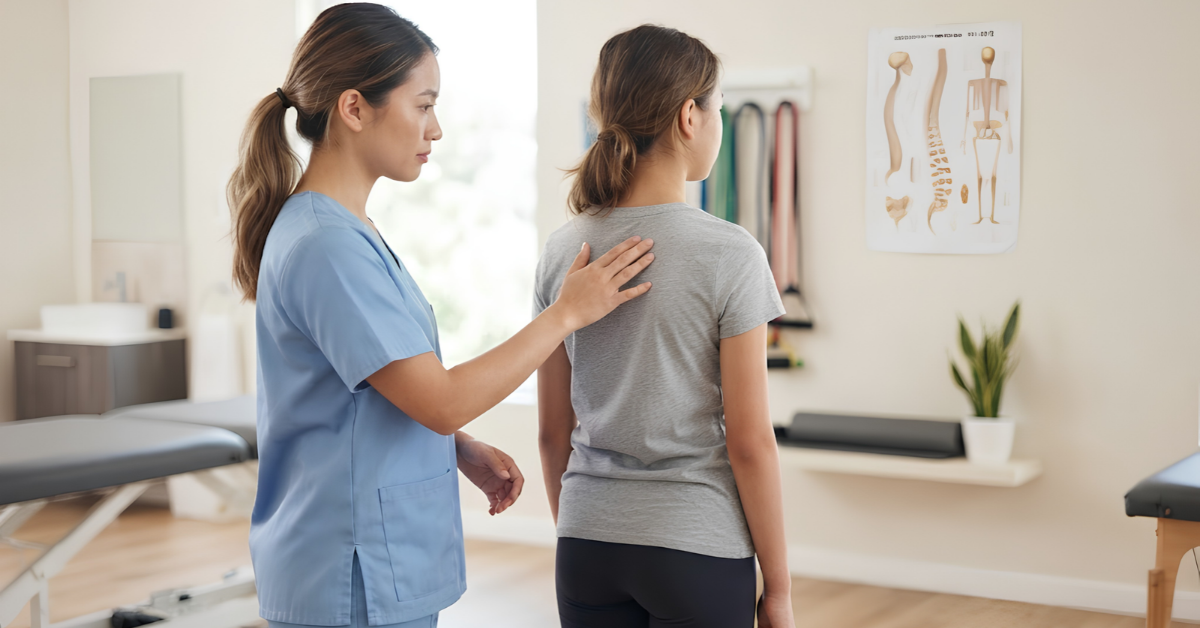
- Postural Assessment: Evaluation of shoulder, pelvic, spinal, and overall body alignment.
- Spinal Movement Assessment: Assessment of spinal mobility, flexibility, and movement patterns.
- Muscle Strength Assessment: Evaluation of core, back, hip, and lower-limb muscle strength and balance.
- Functional Assessment: Analysis of balance, walking, sitting, standing, and other activities affected by postural changes.
Early screening is essential for effective intervention.
Therapy & Management: 12-Week Structured Program
Scoliosis management should be individualized according to age, curve characteristics, severity, symptoms, and functional needs. A 12-week program can provide a structured rehabilitation framework.
Phase 1: Foundation & Awareness (Weeks 1–4)
Goals: Improve postural awareness and Reduce muscle tension and discomfort
Interventions:
- Postural education
- Gentle spinal mobility exercises
- Core activation
Phase 2: Strength & Movement Development (Weeks 4–8)
Goals: Improve core and spinal muscle strength and Develop better movement coordination
Key interventions:
- Progressive core strengthening
- Back and hip strengthening
- Postural correction exercises
Phase 3: Functional Recovery & Confidence (Weeks 8–12)
Goals: Improve functional strength and Develop better movement efficiency
Training includes:
- Advanced spinal stabilization
- Functional strengthening
- Dynamic balance exercises
Advanced Therapy Techniques
- Scoliosis-specific exercises
- Core stabilization
- Postural retraining
- Spinal mobility exercises
Potential Complications
If not addressed early, Scoliosis may lead to:
- Persistent back discomfort
- Persistent back discomfort
- Muscle imbalance
- Reduced spinal mobility
FREQUENTLY ASKED QUESTIONS
Can Scoliosis be cured?
Scoliosis cannot always be completely corrected, particularly when a structural spinal curve is established. However, appropriate management can help improve function, posture, strength, movement control, and symptom management.
Can physiotherapy help with Scoliosis?
Yes. Physiotherapy can help improve muscle strength, flexibility, posture, balance, movement control, and functional capacity. Scoliosis-specific rehabilitation may be included when appropriate.
Can exercise make Scoliosis worse?
Appropriately selected and supervised exercises are generally used to improve strength, movement, and function. Exercise should be individualized according to the person’s age, spinal curve, symptoms, and physical capabilities.
Does Scoliosis get worse with age?
Some curves remain relatively stable, while others may progress, particularly during periods of growth or with certain adult degenerative changes. Regular clinical monitoring may be recommended depending on the type and severity of scoliosis.
RELATED CONDITIONS
- Kyphosis
- Lordosis
- Spinal Stenosis

