

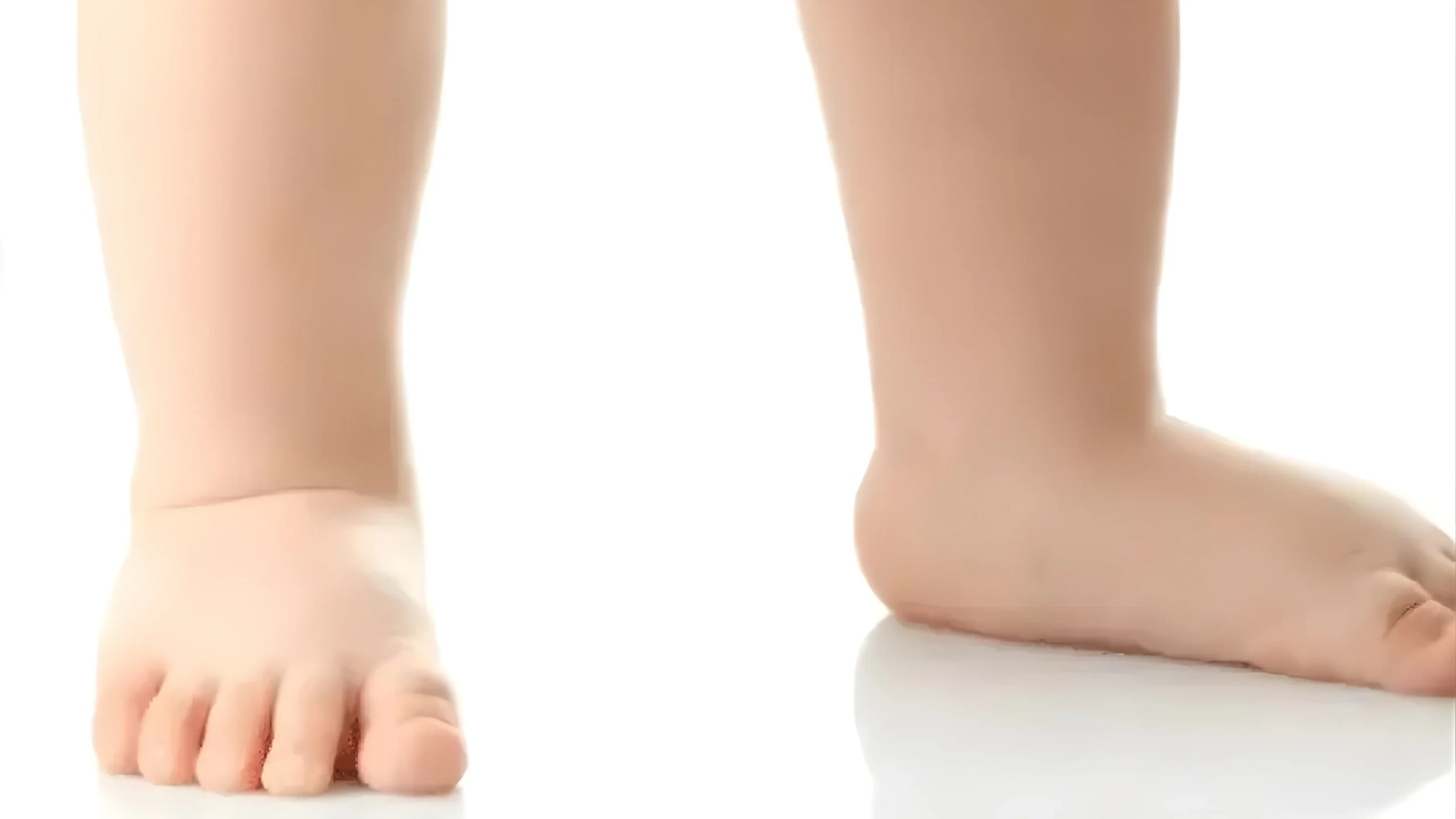
What is Clubfoot (CTEV)?
Clubfoot, medically known as Congenital Talipes Equinovarus (CTEV), is a congenital condition in which a baby’s foot is twisted out of its normal position. The foot appears turned inward and downward, making it difficult to place flat on the ground.
This deformity is present at birth and involves abnormalities in bones, muscles, tendons, and ligaments of the foot and ankle. If left untreated, it can significantly affect walking and overall mobility.
At Physiotherapy Expert, we approach Clubfoot through the principles of Early Correction and Functional Alignment Restoration. Since the condition is highly responsive to early intervention, our focus is on guiding proper foot positioning, improving flexibility, and supporting normal motor development through structured physiotherapy and corrective techniques.
Understanding the Anatomy and Deformity
In a normal foot:
- The foot is aligned straight with the leg
- The sole faces downward
- The ankle allows proper movement
In Clubfoot:
- The foot points downward (equinus)
- The heel turns inward (varus)
- The forefoot is curved inward (adductus)
- The sole may face upward (in severe cases)
This combination of deformities affects both the appearance and function of the foot.
Types of Clubfoot (CTEV)
Clubfoot can present in different forms:
Idiopathic Clubfoot
- Most common type
- Occurs without any associated condition
Syndromic Clubfoot
- Associated with conditions like Spina Bifida
- More complex and rigid
Positional Clubfoot
- Caused by positioning in the womb
- Usually more flexible and easier to correct
Understanding Severity and Functional Impact
Severity depends on stiffness and deformity:
- Mild: Flexible foot, easily corrected
- Moderate: Partial stiffness with limited correction
- Severe: Rigid deformity with significant functional limitation
Early treatment leads to excellent outcomes in most cases.
Common Causes of Clubfoot
The exact cause is not always known, but several factors are associated:
Genetic Factors
– Family history increases risk
Developmental Factors
– Abnormal development of muscles and bones during pregnancy
Neuromuscular Conditions
– Associated with neurological disorders
Environmental Factors
– Limited space in the womb
– Maternal factors during pregnancy
Symptoms: Recognizing the Signs
Clubfoot is usually identified at birth.
Visible Signs
- Foot turned inward and downward
- Smaller foot or calf muscle on affected side
- Shortened Achilles tendon
Functional Signs (if untreated)
- Difficulty in standing or walking
- Walking on the side or top of the foot
Diagnosis: Clinical Approach
At Physiotherapy Expert, diagnosis includes:
- Physical Examination: Assessing foot position and flexibility
- Range of Motion Testing
- Imaging (if needed): X-ray for severe or unclear cases
- Prenatal Ultrasound: In some cases, detected before birth
Physiotherapy Treatment: 12-Week Early Intervention Protocol
Early treatment is crucial and highly effective.
Phase 1: Correction & Mobilization (Weeks 1–4)
Goals: Improve foot alignment and increase flexibility
Treatment includes:
- Gentle stretching exercises
- Manual correction techniques
- Parent education for home care
Phase 2: Stabilization & Strengthening (Weeks 4–8)
Goals: Maintain corrected position and strengthen supporting muscles
Key interventions:
- Splinting or bracing (as prescribed)
- Muscle activation exercises
- Continued stretching
Phase 3: Functional Development (Weeks 8–12)
Goals: Support normal movement patterns and promote motor development
Training includes:
- Weight-bearing activities (age-appropriate)
- Balance and coordination exercises
- Gait training (as child grows)
Advanced Physiotherapy Techniques
- Serial casting (Ponseti method support)
- Bracing and orthotic management
- Neuromuscular stimulation (in select cases)
- Parent-guided home exercise programs
Potential Complications
If untreated, Clubfoot may lead to:
- Permanent deformity
- Difficulty walking
- Pain and disability
- Muscle imbalance
FREQUENTLY ASKED QUESTIONS
Can clubfoot be corrected completely?
Yes, with early and proper treatment, most children achieve normal or near-normal foot function.
Is surgery always required?
No. Most cases are successfully treated with non-surgical methods like the Ponseti technique.
When should treatment start?
Ideally within the first few weeks after birth.
How long does treatment take?
Initial correction occurs within weeks, but bracing may continue for several months to years.
RELATED CONDITIONS
- Flat Foot
- Cerebral Palsy
- Developmental Delay