

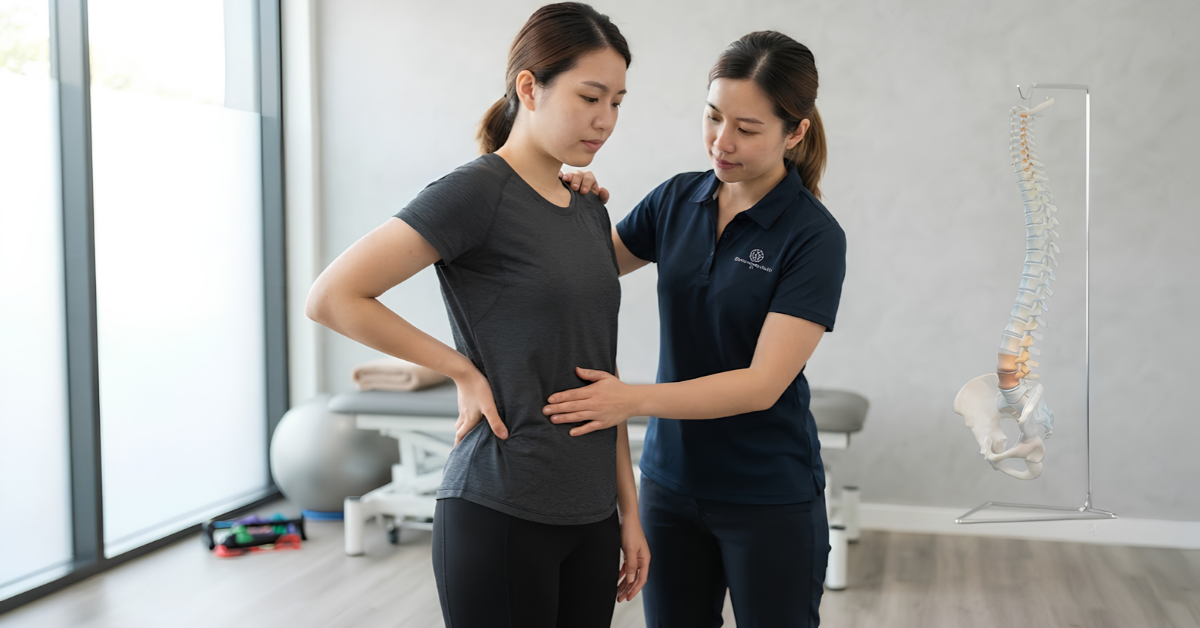
What is Spondylolisthesis?
Spondylolisthesis is a spinal condition in which one vertebra slips forward or backward in relation to the vertebra below it. This can affect spinal stability and may place stress on the surrounding muscles, joints, and nerves.
Spondylolisthesis most commonly affects the lower back, although it can occur in other areas of the spine. Some people have no symptoms, while others may experience lower back pain, stiffness, leg pain, weakness, or difficulty with certain movements.
At Physiotherapy Expert, we approach Spondylolisthesis through structured physiotherapy focused on improving spinal stability, core strength, movement control, flexibility, and functional capacity while reducing stress on the affected area.
Understanding the Condition
Spondylolisthesis occurs when one vertebra shifts from its normal position relative to the vertebra below it. The degree of slipping and the underlying cause can vary between individuals.
- Spinal stability and alignment
- Core and back muscle strength
- Balance and lower-limb coordination
It is commonly associated with lower back pain, stiffness, hamstring tightness, or symptoms that extend into the buttocks or legs.
People with Spondylolisthesis may have no noticeable symptoms or may experience pain and difficulty with activities such as prolonged standing, walking, bending, lifting, or exercising.
TYPES OF SPONDYLOLISTHESIS
Spondylolisthesis can present in different forms:
Isthmic Spondylolisthesis
- Associated with a defect or stress injury in part of a vertebra
- Commonly affects the lower lumbar spine
Degenerative Spondylolisthesis
- Develops due to age-related changes in spinal discs and joints
Congenital Spondylolisthesis
- Develops due to differences in spinal formation present from birth
Traumatic Spondylolisthesis
- Occurs following a significant injury or fracture
- Can cause sudden pain and spinal instability
Understanding Severity and Functional Impact
Severity varies from mild to severe:
- Mild: Mild Spondylolisthesis may cause little or no discomfort, with only minor changes in spinal movement or stability.
- Moderate: Moderate cases may cause persistent lower back pain, stiffness, muscle weakness, or difficulty with prolonged physical activities.
- Severe: Severe Spondylolisthesis may involve significant vertebral displacement, nerve compression, severe pain, weakness, or difficulty performing normal activities.
Early assessment and appropriate management can help identify functional limitations and guide an individualized rehabilitation plan.
COMMON CAUSES OF SPONDYLOLISTHESIS
Spondylolisthesis can develop due to spinal stress, degeneration, abnormal development, or trauma.
Repetitive Spinal Stress
– Repeated extension and loading of the lower back, particularly in certain sports and physical activities, can contribute to stress injuries affecting the vertebrae.
Age-Related Degenerative Changes
– Wear and changes affecting the spinal discs and facet joints can reduce spinal stability and contribute to vertebral slippage.
Congenital Factors
– Some individuals are born with structural differences in the spine that can increase the likelihood of developing Spondylolisthesis.
Trauma and Spinal Injury
– Fractures or significant injuries affecting the vertebrae and supporting structures can cause vertebral displacement.
Symptoms: Recognizing the Signs
Symptoms vary by age and severity.
Back Pain Symptoms
- Lower back pain
- Pain that increases with prolonged standing or activity
- Lower back stiffness
During Daily Activities
- Difficulty standing for prolonged periods
- Discomfort while walking
- Difficulty bending or lifting
Leg and Movement Symptoms
- Pain extending into the buttocks or legs
- Hamstring tightness
- Leg weakness in cases involving nerve compression
Associated Signs
- Reduced spinal mobility
- Muscle weakness
Diagnosis: Clinical Approach
At Physiotherapy Expert, assessment focuses on understanding symptoms, spinal movement, muscle function, and how the condition affects daily activities.
- Clinical Examination: Assessment of pain, posture, spinal movement, muscle tension, and functional limitations.
- Range of Motion Assessment: Evaluation of lumbar and hip movement to identify restrictions or painful movement patterns.
- Strength Assessment: Examination of core, back, hip, and lower-limb muscle strength and control.
- Neurological Assessment: Screening of sensation, muscle strength, reflexes, and other neurological signs when nerve involvement is suspected.
Early assessment and appropriate monitoring can help identify functional changes and guide an individualized management plan.
Therapy & Management: 12-Week Structured Program
Spondylolisthesis rehabilitation should be individualized according to the type, severity, symptoms, spinal stability, and functional requirements of each patient. A 12-week program can provide a structured framework for progressive rehabilitation.
Phase 1: Foundation & Awareness (Weeks 1–4)
Goals: Reduce pain and irritation and Improve postural awareness
Interventions:
- Activity modification
- Gentle lumbar and hip mobility exercises
- Core activation
Phase 2: Strength & Movement Development (Weeks 4–8)
Goals: Improve core and spinal stability and Strengthen the hips and lower limbs
Key interventions:
- Progressive core strengthening
- Gluteal and hip strengthening
- Controlled spinal stabilization exercises
Phase 3: Functional Recovery & Confidence (Weeks 8–12)
Goals: Improve functional strength and endurance and Develop efficient movement patterns
Training includes:
- Advanced core stabilization
- Progressive resistance training
- Functional lifting techniques
Advanced Therapy Techniques
- Core stabilization exercises
- Lumbar stabilization training
- Hip and gluteal strengthening
- Neuromuscular re-education
Potential Complications
If not addressed early, Spondylolisthesis may lead to:
- Persistent lower back pain
- Reduced spinal mobility
- Muscle weakness
- Hamstring tightness
FREQUENTLY ASKED QUESTIONS
Can Spondylolisthesis be cured?
Spondylolisthesis cannot always be completely reversed, particularly when structural changes are established. However, appropriate management can help reduce symptoms, improve strength and stability, and maintain functional ability.
Can physiotherapy help with Spondylolisthesis?
Yes. Physiotherapy can help improve core strength, spinal stability, flexibility, posture, movement control, and functional capacity while helping patients manage pain.
Can exercise make Spondylolisthesis worse?
Appropriately selected and supervised exercises are generally used to improve strength and spinal control. Exercises should be individualized according to the type of Spondylolisthesis, symptoms, severity, and physical capabilities.
Can Spondylolisthesis get worse over time?
Some cases remain stable, while others may progress depending on the underlying cause, age, spinal degeneration, and other factors. Regular medical monitoring may be recommended when there is a risk of progression or significant symptoms.
RELATED CONDITIONS
- Spondylolysis
- Lumbar Spinal Stenosis
- Degenerative Disc Disease

