

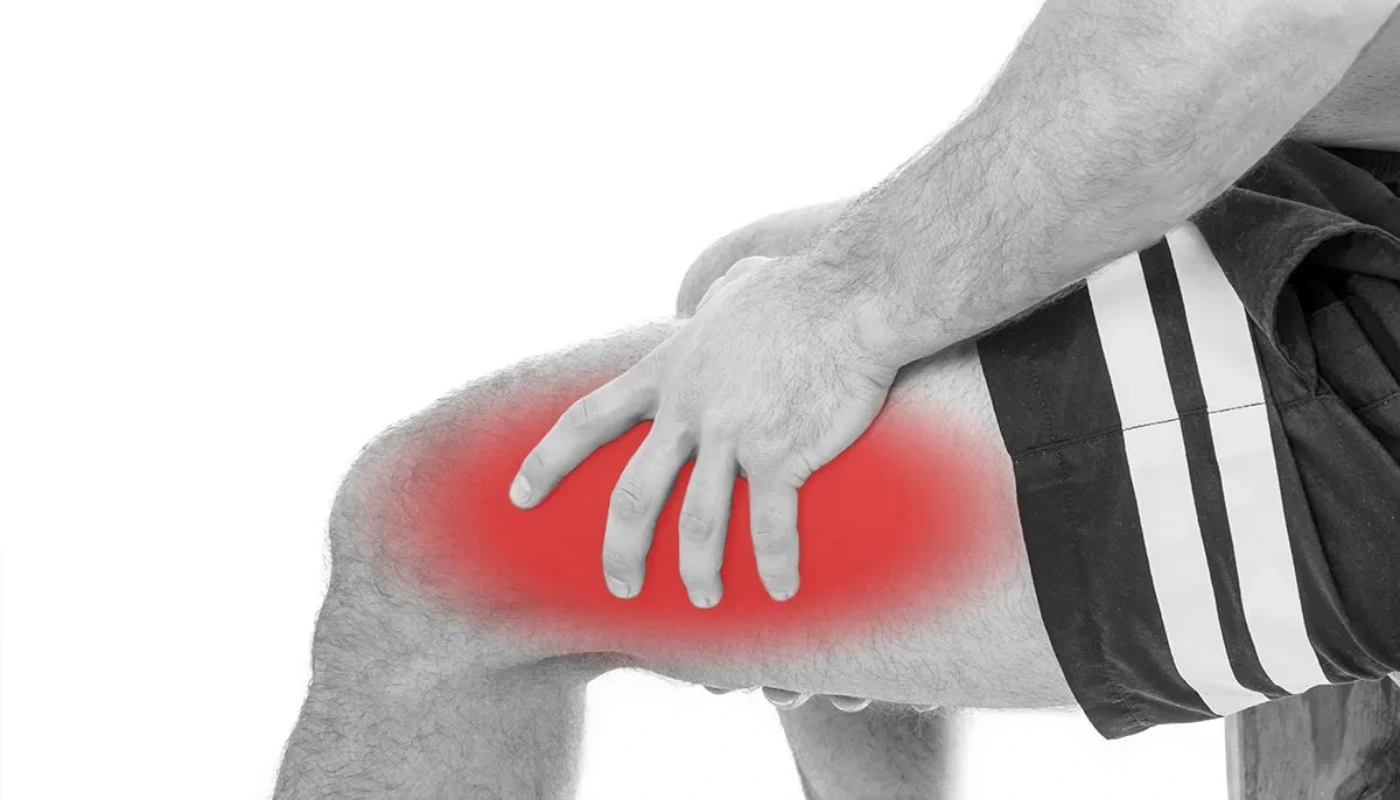
WHAT IS MERALGIA PARESTHETICA?
Meralgia Paresthetica, historically known as Bernhardt-Roth syndrome, is a specific type of sensory mononeuropathy that results in numbness, tingling, and burning pain in the outer part of your thigh. The condition occurs when the Lateral Femoral Cutaneous Nerve (LFCN) becomes compressed, pinched, or trapped as it exits the pelvic cavity.
At Physio Expert, we approach this condition not just as a symptom of “tight clothing,” but as a complex biomechanical entrapment that can significantly impact a patient’s mobility and quality of life. Unlike sciatica, which involves nerves in the lower back that control muscles, Meralgia Paresthetica is purely a sensory issue. This means that while the pain can be excruciating, the patient typically maintains full muscle strength in the leg.
The Evolutionary and Anatomical Context
The human LFCN is an interesting nerve from an evolutionary standpoint. Because humans stand upright, the nerve must make a sharp, nearly 90-degree turn as it passes under the Inguinal Ligament near the Anterior Superior Iliac Spine (ASIS). This sharp angle makes the nerve inherently vulnerable to mechanical friction and pressure. In many individuals, the nerve actually passes through the fibers of the ligament rather than under it, further increasing the risk of entrapment during hip movement.
WHAT ARE THE CAUSES OF MERALGIA PARESTHETICA?
The causes of LFCN compression are categorized into mechanical, metabolic, and traumatic factors.
1. Mechanical Compression (External and Internal)
- Restrictive Clothing: The most common modern culprit. Tight-fitting “skinny” jeans, heavy leather belts, or high-compression shapewear apply direct pressure to the inguinal ligament.
- Heavy Work Equipment: Construction workers carrying tool belts, police officers with duty belts, and photographers with heavy camera bags often suffer from “Belt-Induced Neuropathy.”
- Obesity and Abdominal Girth: A large “panniculus” (abdominal fat fold) can hang over the groin area, creating a constant downward pull and compression on the nerve.
- Pregnancy: Rapid weight gain and changes in pelvic tilt during the third trimester create a perfect storm for LFCN compression.
2. Metabolic and Systemic Factors
- Diabetes Mellitus: Chronic high blood sugar damages the micro-vessels that supply oxygen to the nerves (vasa nervorum). The LFCN, being long and narrow, is often one of the first nerves to suffer.
- Hypothyroidism: Can cause systemic fluid retention (myxedema), which increases pressure within the small canals the nerve travels through.
- Alcoholism: Chronic alcohol consumption can lead to toxic neuropathy, making nerves more susceptible to minor pressure.
3. Trauma and Surgical Complications
- Seat Belt Injuries: During a high-speed collision, the lap belt can “crush” the nerve against the pelvic bone.
- Post-Surgical Scarring: Procedures such as inguinal hernia repair, total hip arthroplasty (via the anterior approach), or bone graft harvesting from the iliac crest can lead to scar tissue entrapment.
WHAT ARE THE SYMPTOMS OF MERALGIA PARESTHETICA?
The symptoms are remarkably localized to a “patch” on the outer thigh, roughly the size of a large book.
- Burning and Stinging: A superficial “electric” sensation on the skin surface.
- Dysesthesia: An unpleasant, abnormal sense of touch where even the friction of loose trousers feels painful.
- Numbness (Hypesthesia): A loss of sensation that makes the outer thigh feel “wooden” or “frozen.”
- The “Pocket” Symptom: Patients often describe the pain precisely where they would keep a phone in their front pocket.
- Aggravation by Extension: Standing for long periods or extending the hip backward stretches the nerve against the ligament, intensifying the burning.
- Relief by Flexion: Many patients find relief by sitting down or slightly bending the hip, which “slacks” the nerve.
PATHOLOGY: THE "CRUSH" MECHANISM
The pathology of Meralgia Paresthetica involves focal demyelination. Nerves are like electrical wires wrapped in insulation (myelin). When the Inguinal Ligament presses against the LFCN, it squeezes the myelin. This causes the nerve to leak electrical signals, which the brain interprets as “pain” or “burning.”
If the pressure is not relieved, the core of the nerve (the axon) begins to die. This is called Wallerian Degeneration. Once the axon dies, the area goes completely numb. At Physio Expert, our primary pathological goal is to restore the blood flow to the nerve and allow the myelin sheath to regenerate before permanent axonal death occurs.
DIAGNOSIS OF MERALGIA PARESTHETICA
Diagnosis at Physio Expert is a process of elimination, as many hip and back issues can mimic this condition.
1. The Clinical “Pelvic Compression Test”
The patient lies on their side. The therapist applies downward pressure to the pelvis for 45 seconds. By compressing the pelvis, we actually slacken the inguinal ligament. If the patient’s symptoms disappear during this test, it is a 95% confirmed diagnosis of Meralgia Paresthetica.
2. Sensory Mapping
We use a cotton wisp and a pin-prick test to map the exact borders of the sensation loss. If the numbness extends to the inner thigh or below the knee, we know the issue is not Meralgia Paresthetica, but likely a spinal disc issue.
3. Electromyography (EMG) and Nerve Conduction (NCS)
While the LFCN is difficult to test because it is deep, a Nerve Conduction Study can measure the latency of the signal. A significant delay compared to the other leg confirms nerve damage.
4. Ultrasound-Guided Assessment
High-resolution ultrasound allows us to see the nerve in real-time. We look for a “swollen” nerve just before it enters the ligament, which is a classic sign of entrapment.
TREATMENT FOR MERALGIA PARESTHETICA
Conservative and Medical Management
- Lifestyle Modification: The first and most important treatment.
- Neuropathic Painkillers: Medications like Gabapentin or Amitriptyline to dampen the nerve’s “firing.”
- Lidocaine Patches: Applied directly to the outer thigh to numb the surface pain.
- Steroid Injections: Injected near the ASIS to reduce the “chemical” inflammation of the nerve.
Surgical Decompression
Reserved for patients who have failed 6 months of physiotherapy.
- Neurolysis: The surgeon “frees” the nerve from scar tissue.
- Transposition: Moving the nerve to a different path so it doesn’t have to make a sharp turn.
PHYSIOTHERAPY TREATMENT AT PHYSIO EXPERT
Our proprietary rehabilitation protocol is designed to decompress the nerve and retrain the surrounding musculature.
Phase 1: Acute Decompression (Weeks 1–2)
In this phase, we focus on removing the “insult” to the nerve.
- Kinesio-Taping for Space: We use a “star-pattern” tape over the ASIS to lift the skin and create a microscopic space for the nerve.
- TENS (High Frequency): 100Hz TENS is used for 20 minutes to “gate” the pain.
- Cold Laser Therapy (LLLT): Laser energy is applied to the nerve exit point to stimulate ATP production and nerve sheath repair.
- Postural Education: We teach the patient how to avoid “Anterior Pelvic Tilt,” which “kinks” the nerve.
Phase 2: Manual Therapy & Tissue Release (Weeks 3–5)
We target the muscles that share space with the LFCN.
- Active Release Technique (ART): We pin the Sartorius muscle and move the hip into extension to “slide” the nerve through the muscle fibers.
- Iliopsoas Release: A tight Psoas muscle can push the nerve forward against the ligament. We use deep manual pressure to relax this muscle.
- Inguinal Ligament Cross-Friction: Gentle massage to break up any micro-scarring that is binding the nerve to the ligament.
Phase 3: Nerve Gliding & Neuro-Dynamics (Weeks 6–9)
Nerves need to move. If a nerve is “stuck,” it hurts.
- LFCN Slump Glides: A specific seated exercise where the patient moves their head and leg in sync to “floss” the nerve back and forth through the pelvis.
- Hip Extension Stretching: Carefully stretching the hip flexors to reduce the mechanical tension on the groin.
- Core Stabilization: Strengthening the Transversus Abdominis to stabilize the pelvis, ensuring the ASIS doesn’t shift and pinch the nerve during walking.
Phase 4: Functional Loading & Prevention (Weeks 10–12)
- Eccentric Quadriceps Training: Ensuring the muscles can handle the load of walking without “guarding.”
- Gait Retraining: Correcting “Trendelenburg gait” or pelvic dropping, which can irritate the nerve during long walks.
- Gradual Return to Sport: For athletes, we reintroduce running on soft surfaces before moving back to hard pavement.
PATIENT EDUCATION: THE "LONG-TERM SUCCESS" CHECKLIST
At Physio Expert, we provide every patient with a lifestyle modification guide:
- Lose Weight: A loss of even 5% body weight can reduce the “hanging” pressure on the inguinal ligament.
- Clothing Choice: Switch to “relaxed fit” jeans. Avoid belts; use suspenders/braces if you work in construction or law enforcement.
- Sleep Position: Sleep on the unaffected side with a thick pillow between your knees to prevent the top leg from crossing over and stretching the nerve.
- Avoid Prolonged Standing: If you must stand, use a small footstool to keep one hip slightly flexed, which reduces LFCN tension.
FREQUENTLY ASKED QUESTIONS
1. Is Meralgia Paresthetica permanent?
2. Can exercise make it worse?
3. How do I know it’s not a slipped disc?
4. Does walking help?
RELATED CONDITIONS
- Trochanteric Bursitis: Inflammation of the hip bone (often confused with MP, but MP is more “surface” pain).
- L2-L3 Radiculopathy: A pinched nerve in the back (requires spinal treatment).
- Femoral Neuropathy: Causes weakness in the quads (MP does not).
- Iliotibial (IT) Band Syndrome: Pain closer to the knee, common in runners.